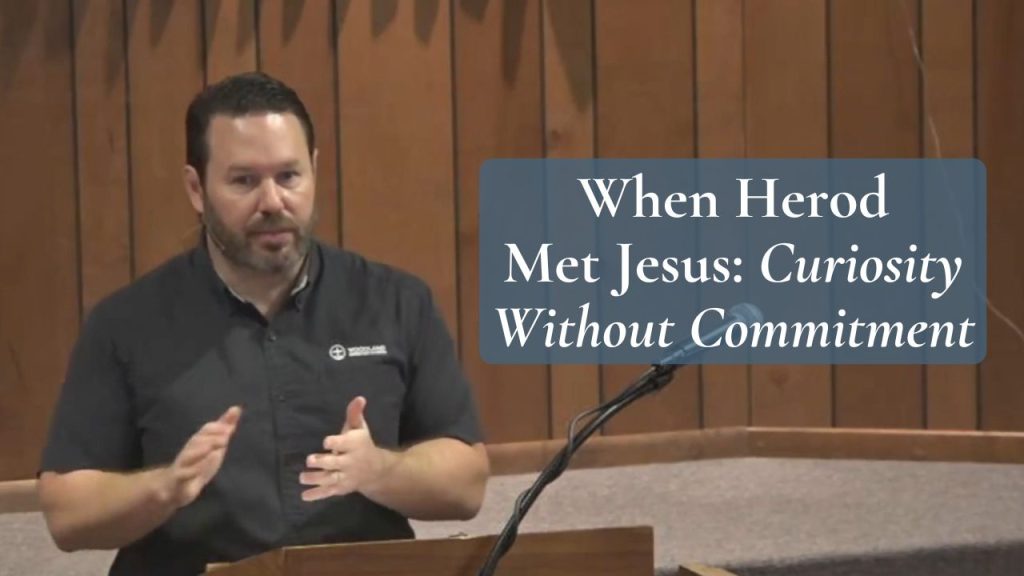
When Herod met Jesus in Luke 23:6–12, he wanted to see a miracle. Jesus answered none of his questions, and Herod joined his soldiers in mocking Him before sending Him back to Pilate. The encounter warns us that curiosity about Jesus can exist without repentance, faith, or a willingness to obey Him.
Podcast: Play in new window | Download
Follow the podcast: Apple Podcasts | Spotify | Amazon Music | RSS
Table of Contents
- Why Pilate Sent Jesus to Herod
- Herod Had Wanted to See Jesus for a Long Time
- Curiosity About Jesus Must Lead to Faith
- Why Was Jesus Silent Before Herod?
- Herod’s Mockery Cannot Change Christ’s Kingship
- What Are We Expecting Jesus to Give Us?
- Being Near Jesus Is Not the Same as Knowing Him
- Respond to Jesus with Repentance and Faith
- Questions for Reflection
- Watch the Sermon
Why Pilate Sent Jesus to Herod
Herod’s encounter with Jesus takes place during the hearings that precede the crucifixion. After the religious leaders bring Jesus before Pilate, they accuse Him of stirring up the people through His teaching. Their mention of Galilee prompts Pilate to ask whether Jesus is a Galilean.
Learning that Jesus comes under Herod’s jurisdiction, Pilate sends Him to Herod, who is also in Jerusalem. This is Herod Antipas, the ruler associated with John the Baptist’s imprisonment and death. The transfer forms another stage in Jesus’ trial, bringing Him before a man who has long wanted to see Him.
You can read the full encounter in Luke 23. Its brevity makes the contrast especially striking: Herod has many questions and considerable excitement, but the meeting ends in contempt.
Herod Had Wanted to See Jesus for a Long Time
Earlier, Luke 9:9 records Herod’s perplexity about reports of Jesus. He knew he had beheaded John, and he wanted to know who this man was about whom he kept hearing. His interest was real, but interest alone tells us little about the condition of a person’s heart.
Luke 23:8 explains what Herod hopes to receive from the meeting: a sign performed before him. He has heard enough to be intrigued. Now he wants a demonstration. The ruler is glad to have Jesus in front of him, but his gladness does not become worship.
Curiosity About Jesus Must Lead to Faith
There is nothing wrong with beginning to ask questions about Jesus. Honest questions can lead us to Scripture and a clearer understanding of the gospel. Herod’s problem is not that he wants to learn. His conduct reveals an interest that demands a performance and then turns to ridicule when Jesus does not provide it.
I remember watching The Last Temptation of Christ when I was younger, probably in my late teens or early college years. I do not remember a particular scene. What concerns me about that portrayal is its departure from the Jesus revealed in the Gospels. A story can make Jesus an object of fascination while distorting who He is.
We need to ask the same question about our own interest. Do we read the Bible to hear God’s Word, or only to find something intriguing? Do we welcome Christ’s commands as well as His promises? We can enjoy religious discussion and still avoid the repentance to which the gospel calls us.
This warning applies wherever Christian ministry becomes preoccupied with spectacle. Miracles in Scripture testify to God’s power and purposes; they do not make Jesus a performer at our command. The church serves people by making Him known and teaching His Word, including the truths that challenge us.
Why Was Jesus Silent Before Herod?
Herod questions Jesus at length, but Jesus gives him no answer. Luke records the silence without explaining every reason for it. In light of Herod’s treatment of John and his conduct here, I understand it as a solemn expression of judgment upon a man who has resisted the truth he has already received.
Jesus owes Herod neither entertainment nor a miracle. His silence is consistent with His refusal to serve the demands of unbelief. The One who shows such compassion for sinners is also the Lord whose words we must take seriously.
The warning is to respond when God’s Word exposes our sin. Repeated resistance can harden us. That does not mean a believer’s experience of unanswered prayer or spiritual dryness proves that God has rejected them. This passage concerns Herod’s contemptuous encounter with Christ, not a formula for interpreting every season when God seems quiet.
Herod’s Mockery Cannot Change Christ’s Kingship
The chief priests and scribes continue their accusations. Herod and his soldiers treat Jesus with contempt, mock Him, dress Him in splendid clothing, and send Him back to Pilate. The hoped-for spectacle gives way to humiliation.
There is tragic irony in the clothing. They ridicule the royal claims surrounding Jesus while standing before the true King. Their contempt also recalls the suffering described in Psalm 22:7, where the righteous sufferer is mocked. Human scorn cannot overturn God’s purpose.
Later, Pilate reports that Herod has found nothing deserving death in Jesus (Luke 23:15). Yet Herod’s treatment of Him is far from honorable. Recognizing no capital offense does not excuse mocking an innocent man and returning Him to the people pursuing His death.
What Are We Expecting Jesus to Give Us?
Herod’s response invites an uncomfortable question: what happens when Jesus does not meet our expectations? We may want relief without correction, blessings without submission, or religious experiences without the patient work of obedience.
It is right to bring our needs to Christ. The problem comes when we make receiving a desired outcome the condition of following Him. Faith learns to receive Him as Lord, including when His wisdom differs from our plans.
The same principle matters in the church. Attractive presentation can help people listen, but it cannot replace the message they need. Our calling is proclaiming the gospel and helping people follow the Savior it reveals. Lasting spiritual nourishment comes from His truth.
Being Near Jesus Is Not the Same as Knowing Him
Luke closes the encounter by telling us that Herod and Pilate became friends that day, having previously been enemies. Their new friendship accompanies the mistreatment of Jesus. Agreement between powerful people does not make their conduct righteous.
John 1:10–11 describes the tragedy of the world failing to recognize its Creator. Herod’s encounter gives us a vivid example of proximity without recognition. Jesus is directly before him, yet Herod treats Him as someone to dismiss.
In the Washington Post’s experiment, acclaimed violinist Joshua Bell played at a Metro station while most commuters passed by. The illustration has limits: hurrying to work is not equivalent to rejecting Christ. But it reminds us that nearness alone does not ensure recognition. Herod’s problem goes deeper than distraction; he responds to Jesus with contempt.
Respond to Jesus with Repentance and Faith
Herod’s story warns us against confusing fascination with faith. We can know Christian vocabulary, attend services, and discuss theological questions while resisting the Lord those things should help us know. We need the spiritual sight that recognizes Christ and receives His truth.
Philippians 2:10–11 looks forward to every knee bowing and every tongue confessing Jesus Christ as Lord. His identity does not depend on our approval. The gracious call before us now is to repent, believe the gospel, and follow Him.
Bring your questions to Scripture, but also bring a willingness to obey what you learn. Ask the Lord to expose the expectations that keep you from hearing Him. Then respond to the Savior with more than curiosity: trust Him and submit to His Word.
Questions for Reflection
- How can you distinguish honest questions about Jesus from a demand that He meet your expectations?
- Is there a truth from Scripture you have repeatedly resisted?
- What would a willing response to Christ look like in your life this week?


2 Responses
Praise God for this wonderful sermon.
I’m thankful it blessed you, Brother!