Podcast: Play in new window | Download
Follow the podcast: Apple Podcasts | Spotify | Amazon Music | RSS
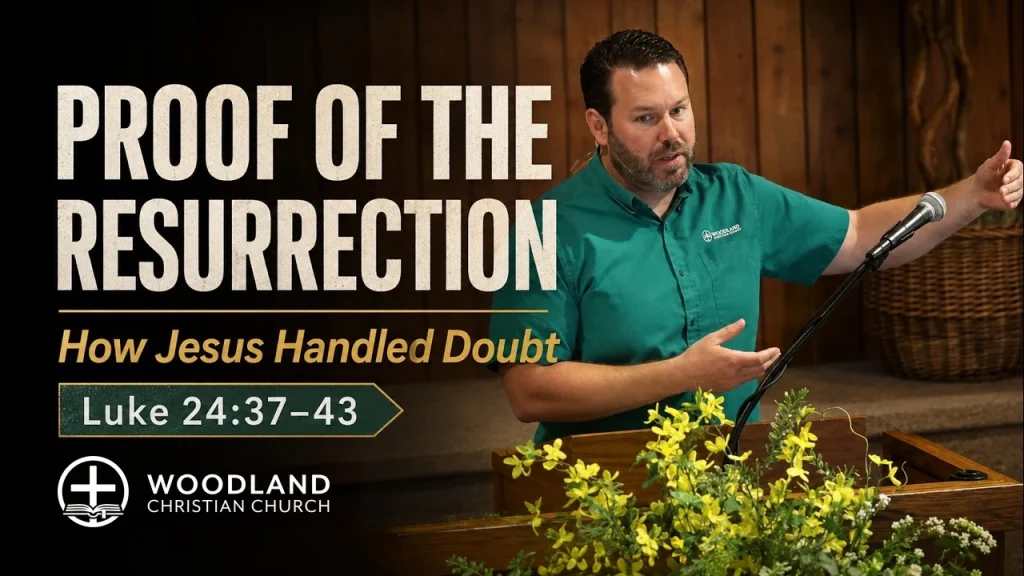
The proof of the resurrection in Luke 24:37–43 is not vague, symbolic, or merely emotional. Jesus did not ask His disciples to believe in a resurrection without evidence. He stood before them, showed them His hands and feet, invited them to touch Him, and even ate in front of them. The risen Christ graciously helped troubled, doubting disciples believe what was gloriously true.
For the last few weeks, we have been walking through Luke 24. We followed the two disciples on the road to Emmaus as their eyes were opened in the breaking of the bread. Then they got up that same hour and walked seven miles back to Jerusalem in the dark, where the other disciples were gathered.
Now we join them in that room. It is late. The doors are shut. Many voices are speaking at once. The women have testified about the empty tomb. Peter has testified that the Lord appeared to him. The two from Emmaus are sharing how Jesus walked with them and made Himself known.
Then, while they were all talking, Jesus Himself stood among them and said, “Peace to you!” But instead of immediately rejoicing, they were startled and frightened. Luke tells us they thought they saw a spirit.
Table of contents
- The Disciples Knew the Truth but Struggled to Trust It
- Jesus Is Gracious with Our Doubts
- The Resurrection Is Physical, Verifiable, and Permanent
- Jesus’ Scars Identify Him
- The Resurrection Should Seem Too Good to Be True
- Jesus Ate to Prove He Was Truly Raised
- Jesus Still Gives Peace to Troubled Hearts
- Conclusion
The Disciples Knew the Truth but Struggled to Trust It
Luke 24:36–37 says:
“Jesus himself stood among them, and said to them, ‘Peace to you!’ But they were startled and frightened and thought they saw a spirit.”
Think about how surprising this is. These were the same people who had spent three years with Jesus. They had heard Him say more than once that He would rise on the third day. They had heard the women’s testimony. They had heard Peter’s testimony. They had heard the testimony of the two disciples from Emmaus. But when Jesus stood right in front of them, their minds reached for the wrong conclusion: “This must be a spirit.”
John’s Gospel adds that the doors were locked because the disciples were afraid of the Jews. Jesus came and stood among them anyway. Yet even then, they did not immediately think, “He is risen!” They thought, “We are seeing a ghost.” This teaches us something important: we can know the truth but still struggle to trust it when it matters.
That is not only true of the disciples in Luke 24. We see something similar in Acts 12. Peter had been arrested by Herod, and the church was earnestly praying for him. God answered their prayer by sending an angel to release Peter from prison. Peter went to the very house where the believers were praying and knocked at the door.
Rhoda heard his voice, recognized him, and ran to tell everyone. But instead of rejoicing that God had answered their prayers, they said, “You are out of your mind.” Then they concluded, “It is his angel!”
In Luke 24, the disciples thought Jesus was a spirit. In Acts 12, the believers thought Peter was represented by an angel. In both cases, the people who should have been most ready to believe struggled to trust what God had done.
We can be the same way. We know what God’s Word says. We have heard it preached. We have shared it with others. But when fear presses in, our hearts can struggle to trust what our minds know.
Knowing and trusting are two different things. The question is not merely whether we know the truth. The question is whether we trust what we know when it counts.
Jesus Is Gracious with Our Doubts
Luke 24:38 says:
“And he said to them, ‘Why are you troubled, and why do doubts arise in your hearts?’”
Jesus asks two questions.
- First, “Why are you troubled?” The word describes being stirred up, agitated, or thrown into turmoil. The disciples were not calm observers carefully evaluating evidence. They were frightened, unsettled, and confused.
- Second, Jesus asks, “Why do doubts arise in your hearts?” The word translated as “doubts” carries the idea of inner conflicts, arguments, and debates. It is as though a debate was raging inside them. One part of them had heard the testimony. One part of them wanted to believe. But another part of them was saying, “This cannot be real. People do not come back from the dead. The doors are locked. This must be a ghost.”
Notice how Jesus responds. He does not disappear. He does not leave them in fear. He does not say, “I cannot believe you still do not trust Me after everything I told you.” He does not condemn them for the argument raging in their hearts. Instead, He graciously gives them what they need:
“See my hands and my feet, that it is I myself. Touch me, and see.”
Jesus is gracious with doubting disciples. We see the same grace eight days later with Thomas. Thomas had said he would not believe unless he saw the mark of the nails and placed his hand into Jesus’ side. When Jesus appeared to him, He did not mock him. He said, “Put your finger here, and see my hands; and put out your hand, and place it in my side. Do not disbelieve, but believe.”
Unbelievers experience unbelief, but believers can experience doubts. The presence of doubt does not automatically mean someone is not a Christian. It means we need to bring those doubts honestly to Christ.
Some Christians are afraid to admit they have doubts. They think it means they are immature, or maybe not believers at all. They fear the Lord will be angry with them. So they keep the debate hidden in their hearts.
But Luke 24 and John 20 show us Christ’s patience. Jesus did not crush weak faith. He strengthened it. He did not reject doubting disciples. He helped them believe.
The Resurrection Is Physical, Verifiable, and Permanent
Luke 24:39–40 says:
“See my hands and my feet, that it is I myself. Touch me, and see. For a spirit does not have flesh and bones as you see that I have. And when he had said this, he showed them his hands and his feet.”
Jesus gives them three forms of evidence.
- First, He gives visual evidence: “See my hands and my feet.” He appeals to their eyes.
- Second, He gives physical evidence: “Touch me, and see.” He invites them to feel that He is not a ghost, vision, or projection.
- Third, He gives a rational argument: “A spirit does not have flesh and bones as you see that I have.” In other words, their conclusion did not fit the evidence before them.
This is important. Jesus was not asking His disciples to believe without evidence. Acts 1:3 says He presented Himself alive “by many proofs,” appearing to them during forty days and speaking about the kingdom of God.
The resurrection of Jesus was not a private feeling, a spiritual metaphor, or a symbolic religious idea. It was physical, historical, and verifiable. He stood in the room. He showed them His wounds. He invited them to touch Him. Then He ate in front of them.
The same body that was crucified was raised. It was glorified, but it was still truly His body.
Jesus’ Scars Identify Him
It is striking that Jesus directed the disciples to His scars. He did not merely say, “Look at Me.” He said, “See my hands and my feet.” He showed them the wounds. Those wounds were meant to kill Him, but after the resurrection, they became the marks of His identity.
This may also help explain what happened on the road to Emmaus. Luke says the two disciples recognized Jesus in the breaking of the bread. Perhaps when He stretched out His hands to break the bread, they saw the wounds.
We see the same thing with Thomas. Jesus invited him to see and touch the marks of His crucifixion. The risen Christ is identified by His scars.
Revelation 5:6 describes Jesus in heaven as “a Lamb standing, as though it had been slain.” This presents Christ in heavenly glory, yet still visibly identified by His sacrifice. We will receive glorified bodies without weakness, sickness, or corruption. But Jesus may be the one person in heaven who still bears scars. His wounds will eternally testify that our salvation was purchased by His suffering. His scars say, “Your sins have been paid for.”
The Resurrection Should Seem Too Good to Be True
Luke 24:41 says:
“And while they still disbelieved for joy and were marveling…”
That phrase sounds strange: “disbelieved for joy.” How can someone disbelieve because of joy? In our language, we might say, “It seemed too good to be true.”
- Imagine a couple who has struggled with infertility for years, and the doctor finally says, “You’re pregnant.” They might weep and say, “I can’t believe it!”
- Imagine a family told that their loved one survived a terrible accident. Then that loved one walks into the room, and they say, “I can’t believe you’re here!”
- Imagine a young man who has worked for years to get into a certain school. He opens the acceptance letter and says, “I can’t believe it!”
In those moments, people are not denying the good news. They are overwhelmed by it. The joy is so great that their hearts can hardly take it in.
That is what was happening with the disciples. They were not rejecting the resurrection. They were overwhelmed. They had watched Jesus be tortured and crucified. They had lived for three days in the grief of losing Him. Their hope that He was the Messiah had been crushed. Now He was standing in front of them alive, speaking peace, showing His scars, and the joy was almost too much to process.
The resurrection should still make us marvel. We should never become so familiar with it that it becomes common to us. Jesus is alive. Death has been defeated. Sin has been paid for. Peace is offered to sinners who deserve judgment. That is not too good to be true. That is the gospel.
Jesus Ate to Prove He Was Truly Raised
Luke 24:41–43 says:
“He said to them, ‘Have you anything here to eat?’ They gave him a piece of broiled fish, and he took it and ate before them.”
Of all the things Jesus could have done, He asked for something to eat. At first, that might seem ordinary. But Jesus knew exactly what He was doing. Spirits do not take food out of your hand, chew it, and swallow it in front of you. Visions do not eat broiled fish. Hallucinations do not share meals. Jesus ate before them to prove He was physically and bodily raised from the dead.
Interestingly, the New Testament repeatedly emphasizes Jesus eating after the resurrection. He broke bread with the two disciples in Emmaus. He ate breakfast with the disciples by the Sea of Galilee. Peter later summarized the resurrection witnesses as those “who ate and drank with him after he rose from the dead.”
Jesus did not need to eat. He asked for food for their sake, not His. Once again, He graciously gave them evidence to strengthen their faith.
Jesus Still Gives Peace to Troubled Hearts
The first words Jesus spoke to them were, “Peace to you.” That was exactly what they needed. They were troubled, frightened, confused, and doubting. Jesus did not begin with rebuke. He began with peace.
And the same risen Christ offers peace today. The peace Jesus gives is not based on circumstances becoming easier. It is not based on our faith always feeling strong. It is based on His finished work. The scars in His hands and feet testify that the price for sin has been paid. His resurrected body testifies that death has been defeated.
Our hope does not rest on a feeling, a wish, or a religious idea. Our hope rests on a living Savior.
Conclusion
In Luke 24:37–43, we see four truths.
- First, we can know the truth and still struggle to trust it when it matters. The disciples heard Jesus’ words. They heard the women’s report. They heard Peter’s testimony. They heard from the two disciples on the road to Emmaus. But when Jesus stood before them, they were afraid.
- Second, Jesus is gracious with our doubts. He did not condemn the disciples for the debate raging in their hearts. He did not walk out on Thomas. He patiently gave them what they needed to believe.
- Third, the resurrection is physical and verifiable. Jesus’ resurrection was not a symbol, feeling, vision, or metaphor. He stood in the room. He showed His hands and feet. He invited them to touch Him. He ate in front of them.
- Fourth, the resurrection should seem too good to be true. Jesus died for sinners, rose from the dead, conquered sin and death, and now offers peace to those who deserve judgment.
So wherever you are today, whether your faith feels strong or whether there is a debate raging in your heart, look to the risen Christ.
- Think of His wounds, and remember that your sins have been paid for.
- Think of His body, and remember that death has been defeated.
- Think of His patience and remember that He is gentle with the weak and the doubting.
The same Jesus who stood among His troubled disciples and said, “Peace to you,” is the same Jesus who offers peace today.