In Haggai 2:15–19, God gives His people a promise tied to a particular date: “From this day on I will bless you.” They had returned to work on the temple, but the work was unfinished and the coming harvest was still months away. God asked them to look back at what life had produced when they neglected Him, look around and obey before they could see results, and look forward to His blessing.
Most of us only carry a few dates in our heads. There are the ones we are supposed to remember: birthdays, graduations, and anniversaries. Sometimes we remember the day we were saved or baptized. People who struggle with an addiction to drugs or alcohol will not tell you they have been sober for “a while.” They will give you a date because there is everything before it and everything after it.
Then there are the dates we wish did not exist: the day we lost a loved one, the day the phone rang and we received terrible news, or the day somebody walked out the door and we never saw them again.
September 11, 2026, marked twenty-five years since September 11, 2001. If we are old enough, we can probably remember where we were and what we were doing when we heard the news. Some dates stay with an entire nation.
In this passage, we see a date the whole nation of Israel could remember. God did not leave it vague. He did not say “sometime that winter.” In verse 18, He named the day—the twenty-fourth day of the ninth month—and in verse 19, He told them, “From this day on I will bless you.”
Podcast: Play in new window | Download
Follow the podcast: Apple Podcasts | Spotify | Amazon Music | RSS
Table of contents
- Haggai 2:15–19 Calls Us to Consider Three Directions
- Look Back at What Life Produced When God Was Not First
- God Might Bless Us When We Obey, Not When We Finish
- Look Around and Obey Whether or Not We Are Blessed
- Look Forward Because Christ Allows Us to Move from Curse to Blessing
- From This Day On: Look Back, Look Around, and Look Forward
Haggai 2:15–19 Calls Us to Consider Three Directions
These verses begin about halfway through Haggai’s third message, which started in verse 10. The previous passage, Haggai 2:10–14, explains why religious activity cannot make us holy. Now God asks the people to consider what their lives have produced.
Three times in these five verses, God says the same thing:
Haggai 2:15a — “Now then, consider from this day onward.”
Haggai 2:18 — “Consider from this day onward, from the twenty-fourth day of the ninth month. Since the day that the foundation of the Lord’s temple was laid, consider:”
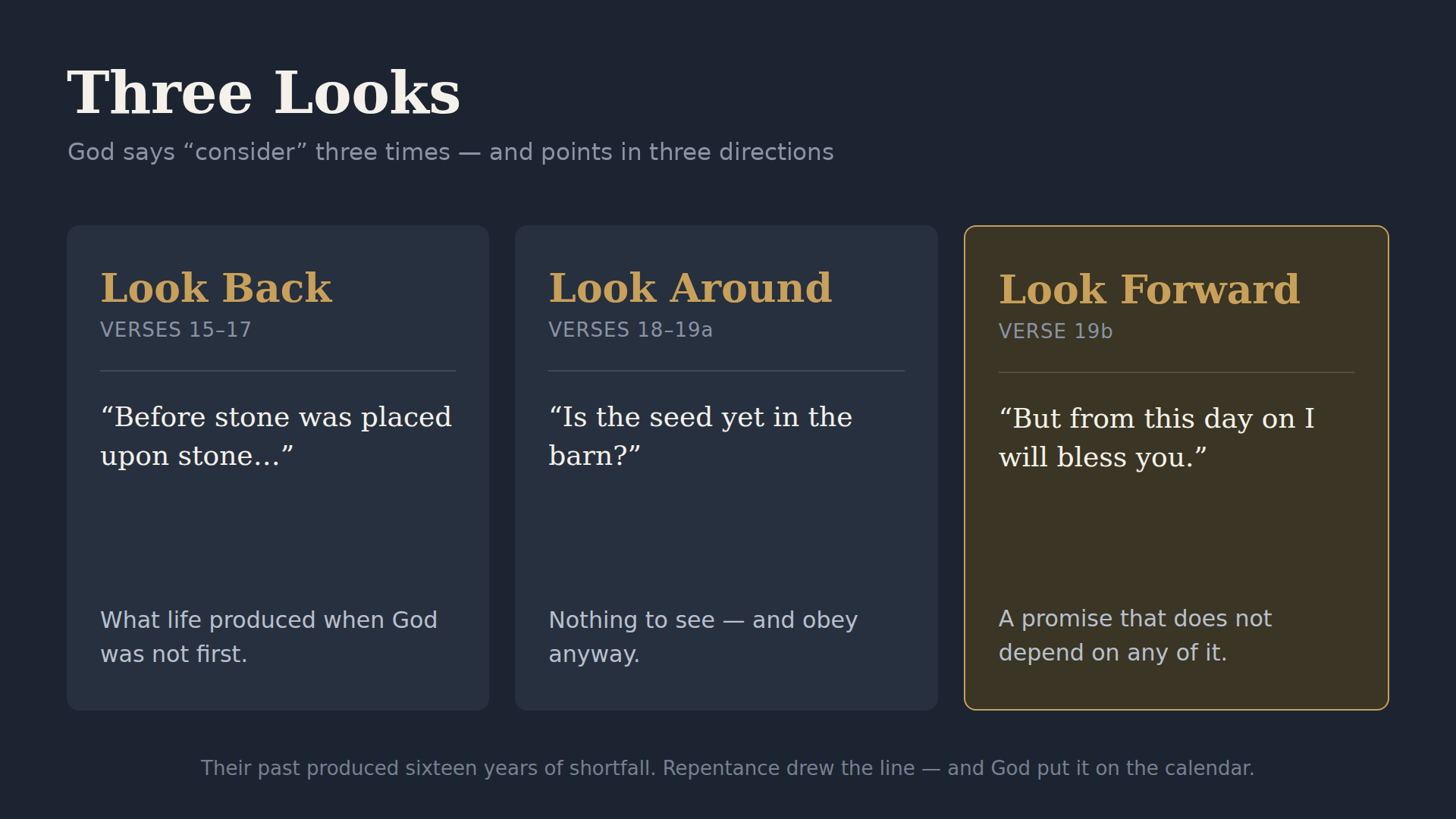
God wants them to consider how things have been going, and the passage points them in three directions: look back in verses 15–17, look around in verses 18–19a, and look forward in verse 19b.
Look Back at What Life Produced When God Was Not First
Haggai 2:15–16 — “Now then, consider from this day onward. Before stone was placed upon stone in the temple of the Lord, how did you fare? When one came to a heap of twenty measures, there were but ten. When one came to the wine vat to draw fifty measures, there were but twenty.”
Many Bibles include a note explaining that the first sentence could refer to looking backward or to days past. God wants the people to remember what life was like when they were neglecting Him. This brings us to the first lesson: look back at what life produced when God was not first.
Haggai is referring to the sixteen-year period during which the people would not build the temple. We considered this in Haggai 1 and the call to put God first: they sowed much and harvested little, they ate but were never full, and they earned wages only to put them in a bag with holes.
Now Haggai gives us numbers he did not give us in chapter 1. They walked up to a pile they estimated had twenty measures and got ten. Half. They went to the wine vat expecting fifty and drew out twenty. Less than half.
This was not one catastrophic year. It was a steady, grinding shortfall year after year for those sixteen years. Every harvest came in far short.
Remember Your History So You Do Not Repeat It
In junior high and high school, all the really good teachers taught math, science, and maybe English. The history teacher was always someone who was just sort of thrown into it—probably also the football coach and PE teacher. I never had any good history teachers, so I was pretty historically bankrupt. It is surprising how little I knew about history when I went to college.
But I remember one thing about history I learned even from bad history teachers: we learn history so we don’t repeat it. Basically, we study it so we learn from our mistakes.
When we read the prophets, a helpful question is, “Why is this prophet saying this to these people?” Why does God make the Jews do arithmetic on sixteen bad harvests? Why bring all of that up now that they have finally repented and gone back to work? They stopped neglecting Him and started working. Why bring up the past?
He wants them to remember their history so they do not repeat it. They could remember, “When I was neglecting God, I went to get twenty measures, but there were only ten. I went to draw fifty measures, but there were only twenty. I kept being struck with blight, mildew, and hail.” Remembering that would keep them from wanting to experience it again.
This has great application for us. Sometimes the healthiest thing we can do is look back and ask, “What was my life like when I was walking in disobedience?” We do not look back to wallow in it. We remember it so we do not repeat it.
What did that season actually produce? What did it cost me, and who else suffered too? What did it promise me that it never delivered?
Remembering what we have been through is one of the strongest protections against going back.
Learn from God’s Discipline
Haggai 2:17 — “I struck you and all the products of your toil with blight and with mildew and with hail, yet you did not turn to me, declares the Lord.”
This is the saddest verse in the passage. When the people were suffering during those sixteen years, they probably thought they were unfortunate. But in chapter 1, God said, “I blew it away,” and “I called for a drought.” He says something similar here: it was not random. He was disciplining them.
What stands out to me is sobering: God was disciplining them, but they were not learning from it. If they had learned, God would not have needed to raise up Haggai and Zechariah to spell it out for them.
Hebrews 12:6, 10–11 — “For the Lord disciplines the one he loves, and chastises every son whom he receives. … he disciplines us for our good, that we may share his holiness. For the moment all discipline seems painful rather than pleasant, but later it yields the peaceful fruit of righteousness to those who have been trained by it.”
The peaceful fruit of righteousness is not for everyone who is disciplined. It is for “those who have been trained by it.” We can go through all the suffering and come out the other side with nothing to show for it. We did not learn anything. We suffered with no benefit.
Proverbs warns us repeatedly about this:
Proverbs 27:22 — “Crush a fool in a mortar with a pestle along with crushed grain, yet his folly will not depart from him.”
A mortar and pestle do a hard thing to a grain of wheat: you pound it until it is not wheat anymore; it is flour. Solomon says you can do that to a man, and he gets nothing out of it. The pressure does not change him. He comes out of the mortar exactly as foolish as he went. This helps explain why Scripture gives specific wisdom for how to deal with fools in.
Discipline by itself does not teach anybody anything. Discipline, plus a humble, repentant heart, teaches. Discipline plus a stiff neck just hurts. Solomon tells us where a stiff neck finally ends:
Proverbs 29:1 — “He who is often reproved, yet stiffens his neck, will suddenly be broken beyond healing.”
Notice the word “often.” God didn’t speak to this man once. This is a man God has spoken to over and over, and every time, he ignores Him and keeps walking. For sixteen years, that was the Jews.
When hardship comes, one of the right questions to ask is, “Lord, what do you want me to learn from this? What do you want me to change?”
You can also take this too far and do real damage. Not all suffering is discipline. Some suffering comes from trials we did not cause, so we have nothing to repent of merely because we are suffering. Do not assign a sin to every trial. But do not swing the other way and assume God never disciplines us to produce repentance.
God Might Bless Us When We Obey, Not When We Finish
Haggai 2:18–19 — “Consider from this day onward, from the twenty-fourth day of the ninth month. Since the day that the foundation of the Lord’s temple was laid, consider: Is the seed yet in the barn? Indeed, the vine, the fig tree, the pomegranate, and the olive tree have yielded nothing. But from this day on I will bless you.”
The dates are important. This is the twenty-fourth day of the ninth month. Compare that with the end of chapter 1:
Haggai 1:14–15 — “And the Lord stirred up the spirit of Zerubbabel the son of Shealtiel, governor of Judah, and the spirit of Joshua the son of Jehozadak, the high priest, and the spirit of all the remnant of the people. And they came and worked on the house of the Lord of hosts, their God, on the twenty-fourth day of the month, in the sixth month, in the second year of Darius the king.”
They returned to work on the twenty-fourth day of the sixth month—exactly three months earlier. During those months, they were doing what God had told them to do in chapter 1: “Go up to the hills and bring wood.” They were hauling timber out of the hills, clearing sixteen years of debris off the old foundation, and quarrying and dressing stone.
One more date helps us understand the significance of God’s promise: the date the building was finished.
Ezra 6:15 — “[The temple] was finished on the third day of the month of Adar, in the sixth year of the reign of Darius the king.”
That was March of 515 B.C., four years and about three months after Haggai 2:18. Put the important dates together: the work stopped in 536 B.C.; sixteen years later, it resumed on September 21, 520 B.C.; three months later, on December 18, 520 B.C., God said He would bless them; and the temple was completed in March of 515 B.C.
Later that same day, God gave Zerubbabel another promise. Read why God called Zerubbabel His signet ring in Haggai 2:20–23.
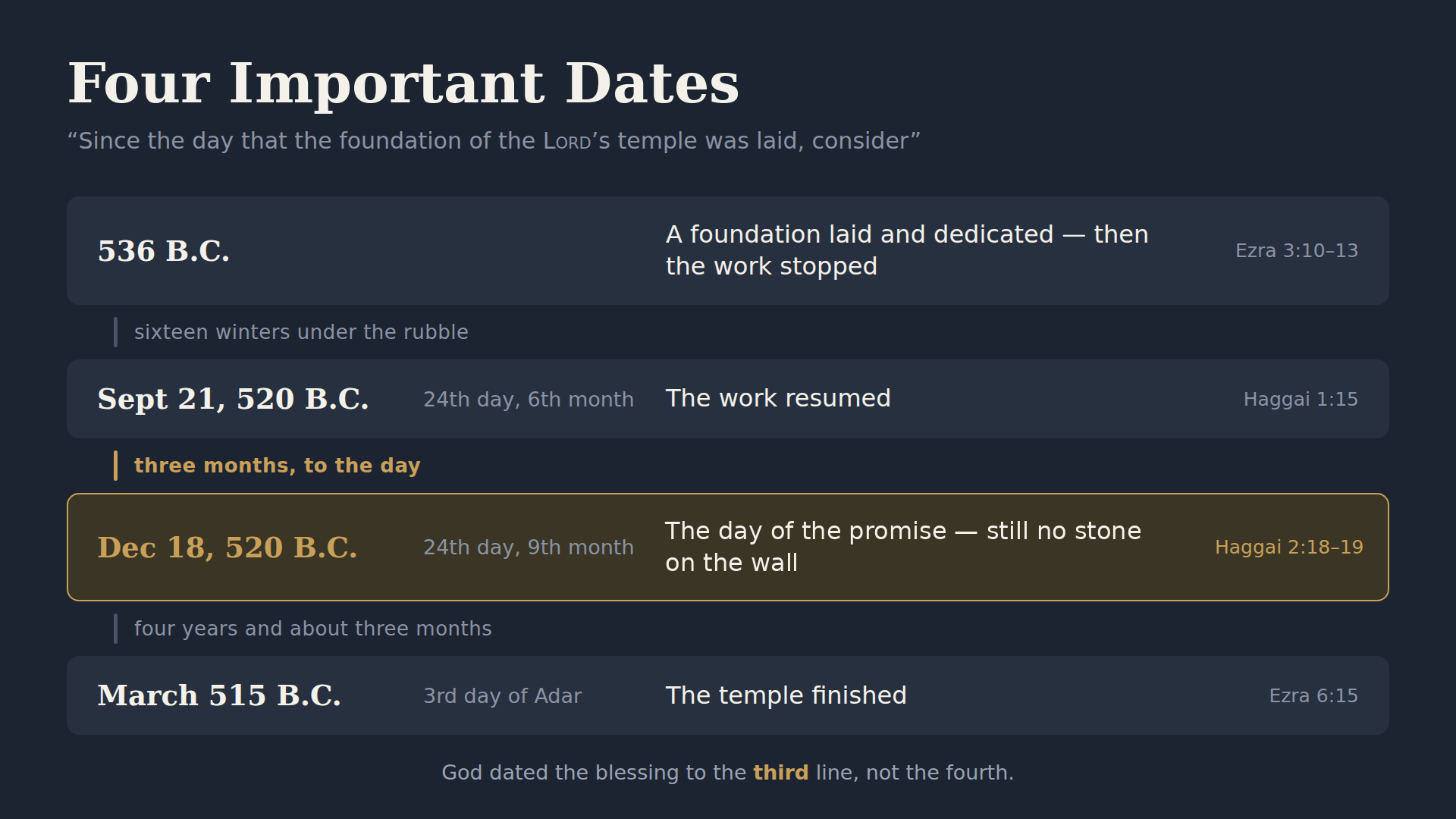
These dates show what God chose to do. He could have waited until the temple was completed, about four and a half years after the work resumed. Instead, He chose to bless the people three months into their renewed obedience.
This brings us to the second lesson: God might bless us when we obey, not when we finish.
I hesitated to make this a lesson because I cannot promise it always happens this way. But we see it in the passage, so I want to draw attention to it. God did not wait for the dedication. He blessed these people three months after they obeyed, and He might do the same for us instead of waiting until we have finished whatever work He has given us.
What Beginning to Obey Can Look Like
Imagine a man who has been a poor husband for years. The work is a rebuilt marriage, and that will take years. But God might start blessing him the night he humbles himself, apologizes to his wife, and asks her forgiveness.
Imagine a woman who has been engaged in a habitual sin, such as gossip or gluttony, that nobody knows about. It might take months to win over it and a lifetime to resist it. But God might start blessing her the day she confesses it to someone else and asks for accountability.
Imagine people who fought with each other and have not spoken in years. Rebuilding the relationship will probably take months or longer. But God might start blessing the moment someone humbles himself, picks up the phone, and expresses a desire to reconcile.
Imagine people who spent too much money and ended up in significant debt. It will probably take years, or even decades, to get out of it. But God might begin to bless when they decide to set up a budget and apply biblical principles to their spending.
These are possibilities, not promises that every circumstance will immediately improve. The point is that God chose to bless the Jews when they repented and began to obey, before they finished all the work. He might do the same with us.
Look Around and Obey Whether or Not We Are Blessed
Haggai 2:19 asks, “Is the seed yet in the barn?” The answer is no. The barn was empty because the people had done what a farmer was supposed to do.
This was the ninth month, Kislev, in mid-December. In that part of the world, the early rains come in October and November. As soon as the ground softens, people sow. By mid-December, the grain was no longer in the barn. It was in the ground.
Then God named four crops: “the vine, the fig tree, the pomegranate, and the olive tree have yielded nothing.” This is not a random list. Listen to how Moses described the Promised Land:
Deuteronomy 8:8 — “a land of wheat and barley, of vines and fig trees and pomegranates, a land of olive trees and honey,”
Haggai names the good things God gave His people in the land and tells them none of them are producing. But in mid-December, they should not expect those harvests yet. Grapes and figs come in late summer. Pomegranates and olives come in the fall.
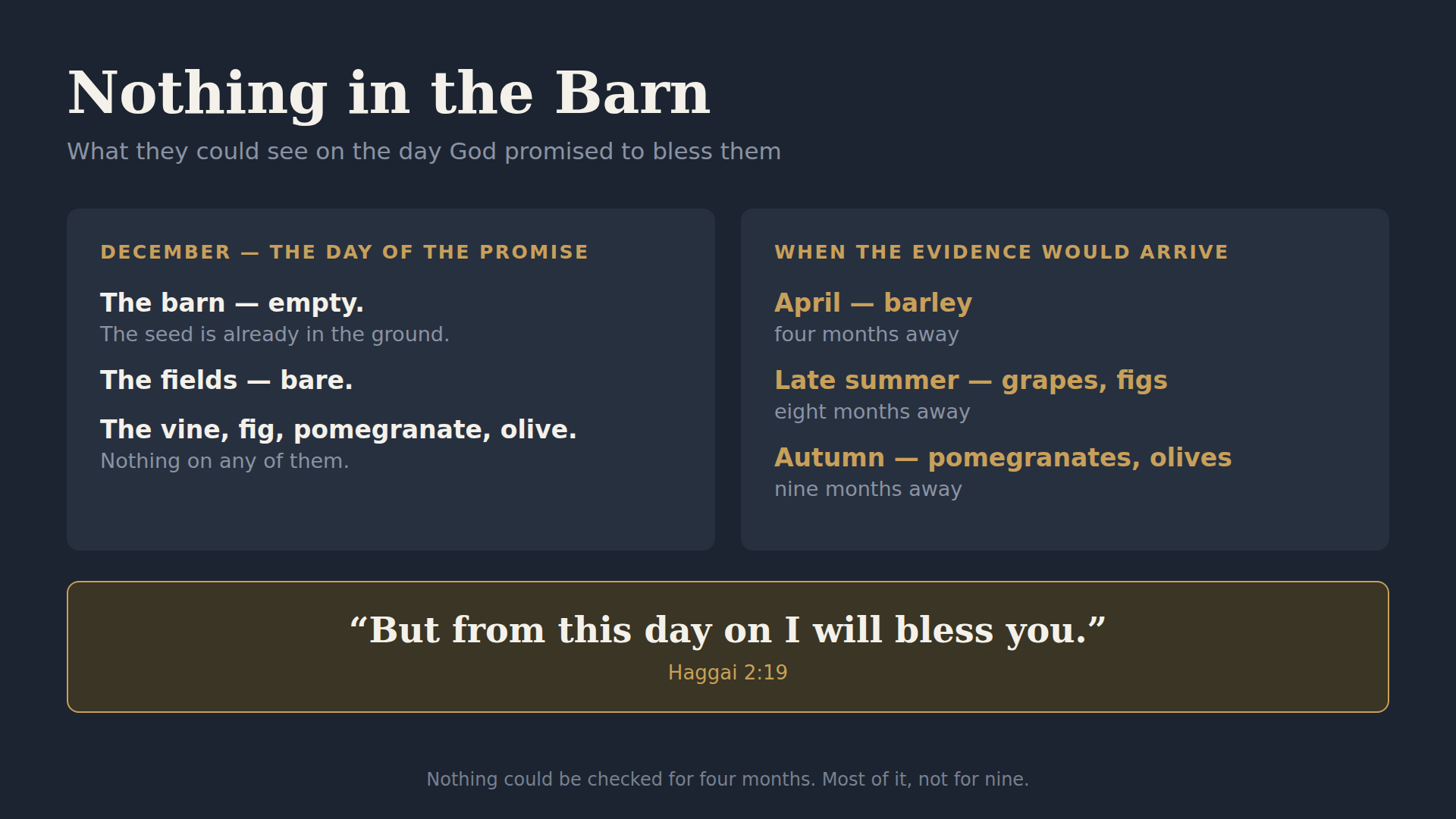
Here was the situation on the day God spoke: the barn was empty, the fields were bare, and the barley would not come in until April—four months away. The crops He named would not produce for eight or nine months. Nothing about this promise could be checked before spring, and most of it could not be checked until the following fall.
Put that together with what the people had already done. Three months earlier, they went back to work. They hauled timber and cleared rubble all autumn. On the day God finally told them He would bless them, they looked around with nothing to show for it.
They obeyed before they saw one thing come of it. That is a good example for us, and it brings us to the third lesson: look around and obey whether or not we are blessed.
Obedience Cannot Depend on Visible Results
First, God does not usually bless us before we obey. If we wait to be blessed before we obey, we will probably never obey.
Second, sometimes we obey, and no blessing comes at all in the circumstances we hoped would change. We can do exactly what God asked and have nothing visible to show for it afterward.
Maybe you have prayed for a child’s salvation for years, but your child seems further from the Lord now than when you first started praying. Maybe you apologized to someone and asked for forgiveness, hoping that would change the person’s attitude, but it is worse now than before.
Maybe you have served faithfully in a ministry for years, but you still cannot see fruit. Maybe you were convicted to give more to the church, and you did, but things seem tighter financially.
Obedience cannot depend on the results. We should obey simply because God said so, not because of what we think we will get out of it. The Jews are a good example for us.
Look Forward Because Christ Allows Us to Move from Curse to Blessing
These verses also prefigure what Christ does for us. In verse 17, God said, “I struck you and all the products of your toil with blight and with mildew and with hail.” These were not random weather events. They were the covenant curse words described in Deuteronomy 28. The people were experiencing the curse.
But the last eight words of verse 19 are, “But from this day on I will bless you.” In three verses, the people moved from cursing to blessing.
This brings us to the final lesson: look forward, because Christ allows us to move from curse to blessing.
Verses 17 and 19 are in the same sermon, on the same day. How did the people move from being cursed to being blessed? They never even got a chance to respond. Haggai was still talking.
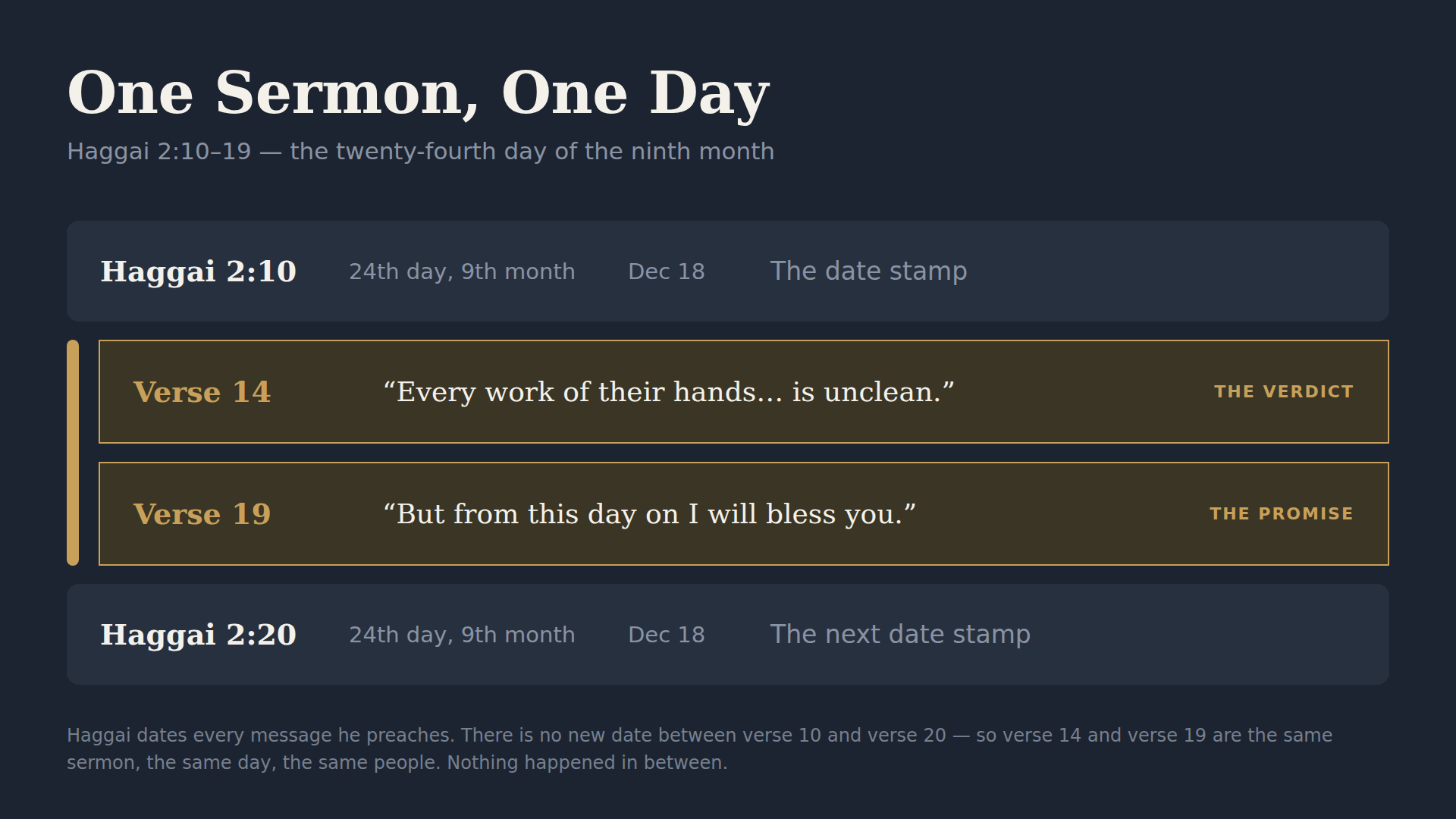
There was no sacrifice offered between those statements, no ceremony, no sprinkling, and no washing. The change was about what God did for them. God Himself removed the curse. It was all grace.
But God cannot simply wave a curse away. When there has been sin, somebody has to bear it. If you write in your Bible, circle “But from this day on I will bless you,” draw a line, and write “Galatians 3:13.”
Galatians 3:13–14 — “Christ redeemed us from the curse of the law by becoming a curse for us—for it is written, ‘Cursed is everyone who is hanged on a tree’—so that in Christ Jesus the blessing of Abraham might come to the Gentiles, so that we might receive the promised Spirit through faith.”
It’s in one sentence: Christ allows us to move from being cursed to being blessed in Him.
Ephesians 1:3 — “Blessed be the God and Father of our Lord Jesus Christ, who has blessed us in Christ with every spiritual blessing.”
Paul continues by describing those blessings: chosen before the foundation of the world, predestined for adoption, redeemed through Christ’s blood, forgiven of our trespasses, showered with the riches of His grace, given an inheritance, and sealed with the promised Holy Spirit (Ephesians 1:4–13).
When God said, “From this day on I will bless you,” He was making a promise whose cost had not yet been paid at the cross. He was looking ahead to His own Son hanging on a tree and bearing the covenant curse. The curse did not simply disappear. It was transferred to Christ.
If you are in Christ, the same thing is true of you: you do not have to earn your way from cursing to blessing. You must repent and believe. Our hope is in Jesus Christ, our righteousness.
From This Day On: Look Back, Look Around, and Look Forward
Look back. Be honest about what a season of neglecting God actually produced in your life. Do not punish yourself over it. Remember it clearly enough that you do not experience it again.
Look around. Maybe you obeyed God months ago, but you have nothing to show for it. The barn is still empty. Be encouraged that you did the right thing because you obeyed regardless of the results.
Look forward. Because of the cross, we can move from the curse of the law to being blessed in Christ. That is where this passage ultimately directs our hope.
Read Haggai 2:15–19 again with these three directions in mind. To follow the message in its context, continue with the previous sermon on why religious activity cannot make us holy.