
One of the most fitting verses for our homes is one you will almost never see on a plaque or wall hanging: Zechariah 4:10, which warns us not to despise the day of small things. Most of our days are filled with small, ordinary tasks, and we are tempted to look right past them. Yet this is exactly the trap the returning Jews fell into while rebuilding the temple—until God sent the prophets Haggai and Zechariah to tell them He took pleasure in the very work they thought was insignificant.
We often think the verses worth framing are the familiar favorites—”Trust in the Lord with all your heart” (Proverbs 3:5–6), “Be still, and know that I am God” (Psalm 46:10), or “As for me and my house, we will serve the Lord” (Joshua 24:15). But the verse that speaks most directly to the ordinary rhythm of our lives is the one that reminds us God rejoices over faithful work that looks small in our eyes.
Podcast: Play in new window | Download
Follow the podcast: Apple Podcasts | Spotify | Amazon Music | RSS
Table of Contents
- The Context: A Small, Struggling Community
- We Obey for God’s Pleasure, Not Our Benefit
- Zechariah’s Vision of the Lampstand
- God Supplies the Strength for the Work He Commands
- The Promises Attached to the Work
- Why the Temple Looked So Small
- God Finds Pleasure in the Small, Ordinary Things We Do
- The Significance of Our Ordinary Work
- Pointing to Christ
- Questions for Reflection
- Watch the Sermon
The Context: A Small, Struggling Community
We have been working verse by verse through the book of Haggai, so let me set the scene. The Jews had returned from exile and begun rebuilding the temple, but then stopped for sixteen years. God raised up Haggai and Zechariah to get them working again. In Haggai 1:6 (ESV), God describes just how poorly life was going for them:
“You have sown much, and harvested little. You eat, but you never have enough; you drink, but you never have your fill. You clothe yourselves, but no one is warm. And he who earns wages does so to put them into a bag with holes.”
Nothing was working out. They planted much and harvested little. They ate but stayed hungry. They drank but stayed thirsty. They dressed but stayed cold. They earned wages, but the money seemed to disappear into “a bag with holes.” Into this discouragement, God gave a command in Haggai 1:8 (ESV):
“Go up to the hills and bring wood and build the house, that I may take pleasure in it and that I may be glorified, says the LORD.”
Haggai 1:8 includes both a command to rebuild the temple and a reason for obeying. The second half of the verse directs our attention to God’s pleasure and glory.
We Obey for God’s Pleasure, Not Our Benefit
Here is a question worth pausing on. Because things were going so badly for the Jews, how would you expect the second half of Haggai 1:8 to read? Something like this, perhaps: “Go up to the hills and bring wood and build the house, that…your lives will be better.” You would expect God to promise full barns, satisfied stomachs, warm clothing, and a wallet that finally holds its money.
But that is not what He says. God told them to build “that I may take pleasure in it and be glorified.”. we should primarily obey for God’s pleasure rather than our own benefit.
Let’s be honest about why we sometimes obey. If you are anything like me, the inner logic often sounds like this: “If I have my devotions, my day will go better.” “If I give, God will protect my finances.” “If I serve, my family will be blessed.” Now, God often does bless obedience. Later in this same book, He tells these very people, in Haggai 2:19 (ESV), “From this day on…I will bless you.” But being blessed should not be the primary motive.
Consider the problem with obeying merely to be blessed: what happens when we obey and the blessing does not come? We lose our motivation, and we may even feel shortchanged, as though God failed to hold up His end of the bargain. But when God’s pleasure is our aim, we will always be motivated to obey. Paul lived this way. In 2 Corinthians 5:9 (ESV), he writes, “Whether we are at home or away, we make it our aim to please him.” An aim is a target you point at. Whatever Paul was doing—tentmaking, traveling, preaching, sitting in prison—the target never moved.
Enoch’s entire life is summarized in a single phrase in Hebrews 11:5 (ESV): he “was commended as having pleased God.” Imagine your whole life summarized in five words. Could there be a better five?
And here is what stands out to me most: the LORD of hosts, who commands the armies of heaven, said that the obedience of this small, struggling community would bring Him pleasure. That is deeply encouraging, because it means my little obedience can please God too.
Zechariah’s Vision of the Lampstand
Haggai and Zechariah were contemporaries, prophesying at the same time, and Zechariah was making a strikingly similar point. God gave Zechariah eight visions, and we are looking at the fifth. It begins in Zechariah 4:1–3 (ESV), where an angel wakes Zechariah “like a man who is awakened out of his sleep” and asks what he sees. Zechariah describes a lampstand all of gold, with a bowl on top and seven lamps, flanked by two olive trees.
This is the temple lampstand—the menorah—with seven branches, each holding its own lamp. Since Zechariah was speaking to people rebuilding the temple, it makes sense that God gave him a vision involving something used in the temple. And here is the crucial detail: lamps like these demanded constant work. Every morning the priests trimmed the wicks, cleaned away the soot, and refilled the lamps with olive oil that had to be produced by grinding and pressing olives. Keeping the lamps burning took continual human effort.
But in the vision, everything is different. There is a bowl above the lampstand serving as a reservoir, and two olive trees whose branches drip oil directly into the bowl. Look at Zechariah 4:12 (ESV): the two branches pour golden oil out through golden pipes. The oil flows from the trees to the bowl to the lamps—an abundant, essentially limitless supply—with no human effort at all. No one grinds the olives. No one presses the oil. No one refills anything.
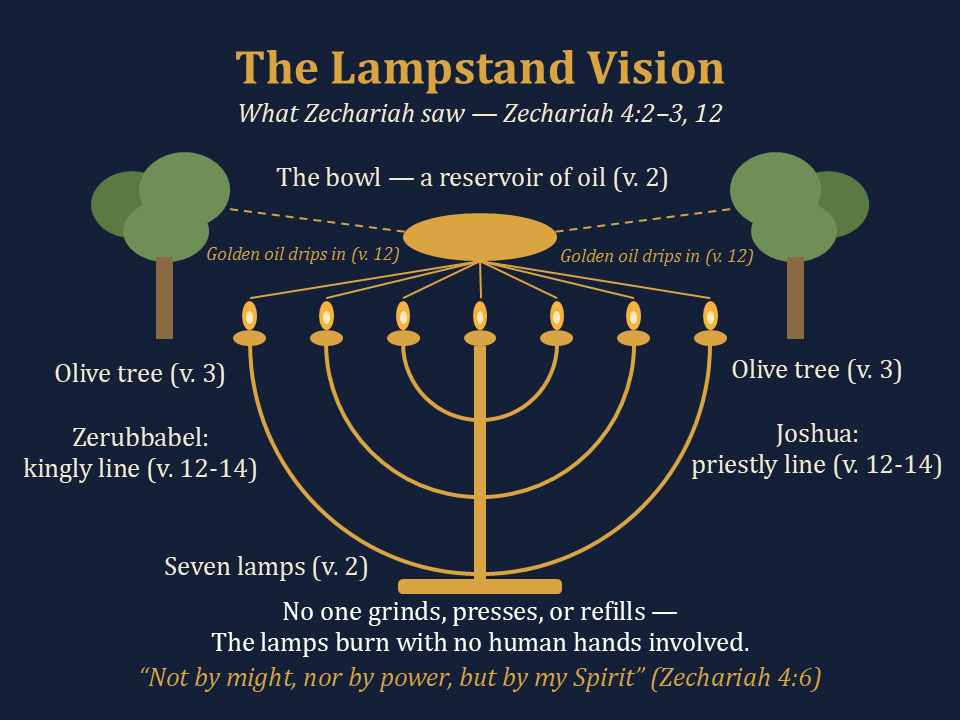
The Lampstand Vision (Zechariah 4:2–3, 12): oil flows from the olive trees to the bowl to the seven lamps—”Not by might, nor by power, but by my Spirit.”
God Supplies the Strength for the Work He Commands
When Zechariah asks the angel what the vision means, the angel gives the interpretive key in Zechariah 4:6 (ESV):
“This is the word of the LORD to Zerubbabel: Not by might, nor by power, but by my Spirit, says the LORD of hosts.”
Throughout Scripture, oil often pictures the Holy Spirit. So the vision teaches that the work would be accomplished not by human effort but by the power of God’s Spirit. Just as the olive trees supplied oil to keep the lamps burning, God’s Spirit would supply the strength for Zerubbabel and the Jews to finish. God supplies the strength for the work He commands.
This is the first reason I wanted to study Haggai 1:8 and Zechariah 4 together. Set the two prophets side by side and see how their messages fit. Haggai says, “Go up to the hills and bring wood and build”—the people had to act, and it was surely exhausting. Zechariah says, “Not by might, nor by power, but by my Spirit”—God would empower them to do it. Together, these two messages describe the whole Christian life.
Paul put both truths in a single verse more than once. In Colossians 1:29 (ESV) he says, “For this I toil, struggling with all his energy that he powerfully works within me.” Paul is working hard—but with the energy God provides. And in Philippians 2:12–13 (ESV) he writes, “work out your own salvation with fear and trembling, for it is God who works in you, both to will and to work for his good pleasure.” We work while God is working in us. And do not miss the last three words—”his good pleasure.” Again, God’s pleasure is the point.
Here is the application. We so often try to do the right things on our own strength. We try to raise children for Christ on willpower and exhaustion. We try to break a sin habit in our own power. We serve in the church running on fumes because we rely on ourselves. The work is commanded, so we must do it—but if God wants us to do it, we can also trust Him to give us the strength. He will not assign something without empowering us for it. As one commentator put it: if we are worn out, the answer is not less obedience; it is more dependence.
The Promises Attached to the Work
Look at the promises God attaches to this small, difficult project. In Zechariah 4:7 (ESV), God says, “Who are you, O great mountain? Before Zerubbabel you shall become a plain. And he shall bring forward the top stone amid shouts of ‘Grace, grace to it!'” The “great mountain” may represent the opposition they faced, or the enormous pile of rubble left from the temple’s destruction. Either way, God promised to level it.
Then in Zechariah 4:8–9 (ESV), God promises that “the hands of Zerubbabel have laid the foundation of this house; his hands shall also complete it.” The same hands that laid the foundation would set the top stone—and that is exactly what happened. Ezra 6:14–15 (ESV) records that the Jews “built and prospered through the prophesying of Haggai…and Zechariah,” and the house was finished on the third day of the month of Adar—March 12, 515 BC. That was about four years after Zechariah’s vision. Not decades down the road, not in the next generation, but by Zerubbabel’s own hands, just as God said.
Why the Temple Looked So Small
To feel the weight of the next verse, we need some background. King David was a man of war who spent decades subduing Israel’s enemies, and he passed on to Solomon a kingdom completely at peace—1 Kings 5:4 (ESV) says Solomon had “rest on every side.” David could not build the temple himself because he had shed so much blood, so he did everything possible to set Solomon up for success, stockpiling gold, silver, bronze, iron, and cut stone in staggering quantities (1 Chronicles 22:14–16, ESV).
Solomon simply had to build, and he made the temple a wonder of the ancient world: interior walls, floors, and altar overlaid entirely in gold; cedar paneling carved with cherubim, palm trees, and flowers; towering bronze pillars and a massive bronze basin resting on twelve bronze oxen. Notice two things: Solomon built with no opposition and with almost unlimited wealth.
The returning exiles faced the exact opposite situation. First, Ezra 4 tells us they faced active, organized opposition—neighboring peoples intimidated them, hired counselors against them, and eventually got the work halted by royal decree. Second, they had very limited resources; they were a small, poor community rebuilding out of rubble. Remember, God told them to “go up to the hills and bring wood”—they had to gather their own materials, whereas Solomon had everything handed to him.
Now add one more detail. Some of the Jews rebuilding had seen Solomon’s temple with their own eyes before it was destroyed, and even those who had not seen it had heard all about it—it was one of their greatest sources of national pride. So when they laid the foundation for the new temple, how do you think it looked by comparison? It looked pathetic. It looked so poor that some who remembered Solomon’s temple wept aloud at the sight.
God Finds Pleasure in the Small, Ordinary Things We Do
With that background, hear what God says in Zechariah 4:10 (ESV): “For whoever has despised the day of small things shall rejoice, and shall see the plumb line in the hand of Zerubbabel. These seven are the eyes of the LORD, which range through the whole earth.”
“Day of small things” perfectly describes that entire era: a small remnant, a small foundation, a small amount of wealth, a small amount of resources, a small temple. A plumb line is the tool builders use to make sure a wall rises straight and true. And “these seven” refers to the seven lamps from the vision, “the eyes of the LORD, which range through the whole earth.” Seven often signifies completeness, so this symbolizes God’s perfect, complete sight—nothing on earth escapes Him, including a modest construction site in a backwater province of the Persian Empire.
There is an important translation note here. Though I love the ESV, it reads differently from most translations in this verse. In the ESV, the ones who “shall rejoice” appear to be the people who despised the day of small things. But most other translations—the KJV, NKJV, NASB, NIV, and CSB—assign the rejoicing to the eyes of the LORD. In other words: “The eyes of the LORD rejoice to see the plumb line in the hand of Zerubbabel.” His eyes range through the whole earth, and when they pass over that small, unimpressive job site, they do not merely observe—they rejoice.
This is the second reason I wanted to study these two passages together, because both prophets make the very same point. Haggai 1:8 says, “Build the house, that I may take pleasure in it.” Zechariah 4:10 says, in effect, “My eyes rejoice to see the work being done.” Which reveals how sad and ironic the people’s attitude was: they despised the very thing God took pleasure in. It looked insignificant to them, but God rejoiced in it. God finds pleasure in the small, ordinary things we do.
If you are a parent, think about what you hang on the refrigerator. No offense to the children, but we are not putting up masterpieces—we are taping up scribbles, lopsided houses, purple suns, and stick figures with arms coming out of their heads. We do not display them because of the craftsmanship; we display them because we delight in what our children do. We are pleased with the work not because of the work itself, but because of the heart behind it.
Next to Solomon’s temple, the new temple looked like our children’s refrigerator art. But God was pleased with it. He rejoiced in the work being done. And here is why that matters so much for us: just as the Jews thought their work was insignificant, we may think ours is too. But just as God took pleasure in their work, He takes pleasure in ours.
The Significance of Our Ordinary Work
Consider the father going to work each day—the alarm, the commute, the same tasks done for the ten-thousandth time to provide for his family. The world calls it a grind, but when a Christian man works to provide, he is serving the Lord, who is pleased with his effort. Colossians 3:23–24 (ESV) says, “Whatever you do, work heartily, as for the Lord and not for men…You are serving the Lord Christ.” Even when a man works for an earthly employer, twice the passage says he is actually working for the Lord.
Consider the mother doing laundry, meals, and cleaning—work that is largely undone by the end of the day and invisible to nearly everyone. It might seem insignificant, but God takes pleasure in it, which makes it significant. Somewhere between the washer and the dryer, a mother is doing what God rejoices to see.
And consider the children obeying their parents and doing their chores. Kids, this verse is for you—Colossians 3:20 (ESV): “Children, obey your parents in everything, for this pleases the Lord.” There is our word again: pleases. You do not have to wait until you are grown to bring God pleasure. You can do it before lunch.
So here is the truth to take home: if we are doing what God wants us to do, it does not matter how small and insignificant it looks in the eyes of others—we are doing great things, because we are bringing God pleasure.
Pointing to Christ
Let me conclude the way Zechariah does—by pointing to Christ. At the end of the vision, Zechariah asks about the two olive trees, and the angel answers in Zechariah 4:14 (ESV): “These are the two anointed ones who stand by the Lord of the whole earth.” The two anointed ones—literally “sons of new oil” in Hebrew—are Zerubbabel and Joshua. Zerubbabel the governor represents the royal line; Joshua the high priest represents the priestly line. These are the two channels through which God’s Spirit flowed to build His house.
We are the spiritual house God is building, and these two anointed men point forward to the true and greater Anointed One. That is what “Messiah” and “Christ” mean: Anointed One—the one who unites both offices, King and Priest, in Himself. And when the Anointed One came, how did He come? Small. Insignificant. Born in little Bethlehem. Raised in Nazareth.
So leave with this: when we are faithful in the small and seemingly insignificant, it is a wonderful way to resemble our Savior. We should never despise the day of small things, because God Himself does not despise them—He takes pleasure in them.
Questions for Reflection
- Why is God’s pleasure a better measure of faithful work than visible size or success?
- Where do you need to depend on His strength rather than your own?
- What small act of obedience might you be tempted to dismiss?