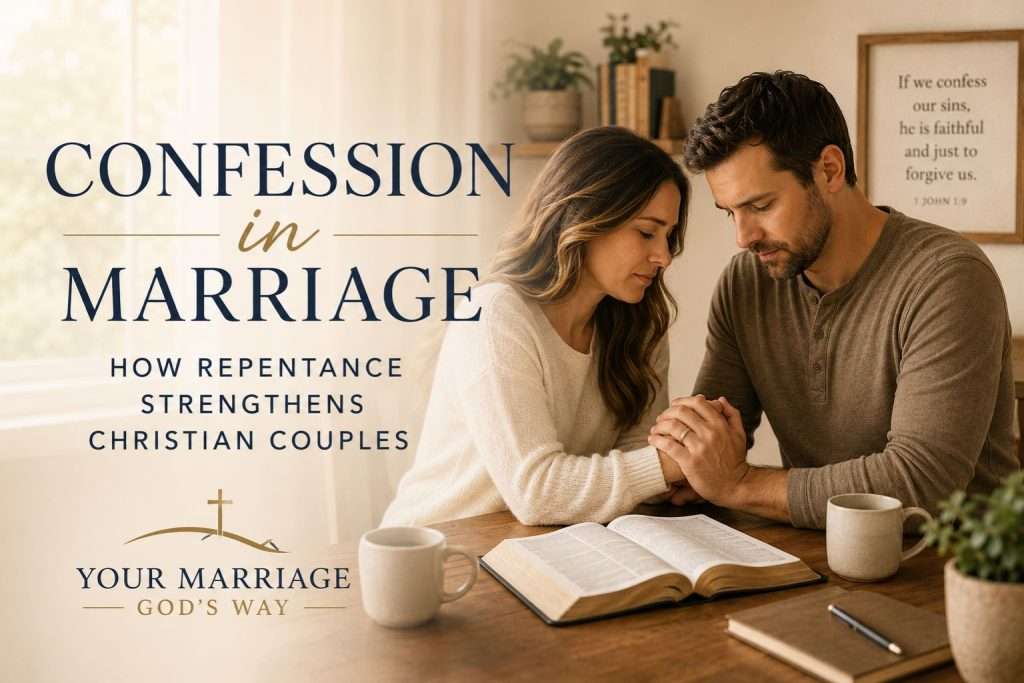
Confession in marriage is one of the clearest ways husbands and wives live out the gospel at home. Every husband and wife sins. We speak harshly. We grow selfish. We assume the worst. We become defensive. We withhold affection. We make excuses. The question is not whether we will sin against each other, but whether we will humble ourselves, confess our sin, repent, and seek forgiveness.
A strong Christian marriage is not built by two perfect people. It is built by two sinners who keep going to Christ and then to each other with humility, honesty, and grace. Marriage gives us daily opportunities to obey James 5:16:
“Therefore, confess your sins to one another and pray for one another, that you may be healed.”
This does not mean every passing irritation needs to become a long emotional discussion. But it does mean that when we sin against our spouse, we should be willing to say so plainly. Not vaguely. Not defensively. Not while shifting blame. Plain confession is one way God brings healing to a marriage.
Table of contents
- Why Confession in Marriage Matters
- Confession Is Not the Same as Excuse-Making
- Repentance Goes Beyond Saying Sorry
- Confession Helps Couples Fight Sin Instead of Fighting Each Other
- Why Confession Is Hard in Marriage
- How Husbands Can Lead in Confession
- How Wives Can Practice Godly Confession
- Confession Should Be Specific and Sincere
- Forgiveness Must Reflect the Gospel
- Confession Should Become Normal, Not Rare
- What If Your Spouse Does Not Confess?
- Practical Ways to Grow in Confession in Marriage
- A Marriage Marked by Grace
Why Confession in Marriage Matters
Many couples want peace but not repentance. They want closeness, but they avoid confession. They want the tension to go away, but they do not want to say, “I was wrong.” Yet Scripture repeatedly connects humility with grace:
“God opposes the proud but gives grace to the humble” (James 4:6).
Pride keeps spouses apart. Humility draws them back together.
When husbands and wives confess sin, they do not weaken the marriage. They are making honesty normal. They are saying, “We do not have to pretend. We can walk in the light before God and each other.” First John 1:7 says:
“But if we walk in the light, as he is in the light, we have fellowship with one another.”
Although this verse is first about fellowship with God and fellow believers, the principle certainly applies in marriage. Darkness harms fellowship. Hidden sin harms intimacy. Pride harms unity. But walking in the light strengthens trust.
Confession Is Not the Same as Excuse-Making
One reason confession in marriage is so powerful is that it refuses to hide behind excuses. There is a big difference between saying, “I’m sorry you were hurt.” And saying: “I sinned against you when I spoke harshly. I was wrong. Will you forgive me?”
The first statement can sound like an apology, but it does not necessarily take responsibility. The second statement names the sin, owns the fault, and seeks reconciliation.
Biblical confession does not sound like Adam in the garden:
“The woman whom you gave to be with me, she gave me fruit of the tree, and I ate” (Genesis 3:12).
Adam blamed Eve and indirectly blamed God. That is what our flesh wants to do too. We say:
- “I only yelled because you kept pushing me.”
- “I wouldn’t have responded that way if you had been more respectful.”
- “You know how tired I am.”
- “You always make things worse.”
There may be circumstances surrounding the sin, but circumstances do not excuse sin. A harsh word is still a harsh word. A selfish attitude is still selfish. Bitterness is still bitterness. Silence used as punishment is still unloving. Confession says, “Regardless of what you did, I am responsible for what I did.”
Repentance Goes Beyond Saying Sorry
Second Corinthians 7:10 says:
“For godly grief produces a repentance that leads to salvation without regret, whereas worldly grief produces death.”
There is a kind of sorrow that is mostly upset about the consequences. A husband might be sorry the conversation turned into an argument. A wife might be sorry about the distance in the home. But godly grief is different. Godly grief is grieved over sin because it dishonors the Lord and hurts another person.
Repentance in marriage means more than saying, “I’m sorry.” It means turning from sin and seeking to change. A repentant spouse does not say: “That’s just how I am.” Instead, repentance says: “By God’s grace, I want to become more like Christ.” Ephesians 4:22-24 describes this kind of change:
“Put off your old self, which belongs to your former manner of life and is corrupt through deceitful desires… and put on the new self, created after the likeness of God in true righteousness and holiness.”
In marriage, repentance often looks very practical. It may mean putting off harsh speech and putting on gentleness. Putting off defensiveness and putting on teachability. Putting off selfishness and putting on service. Putting off bitterness and putting on forgiveness.
Confession Helps Couples Fight Sin Instead of Fighting Each Other
One of the most damaging patterns in marriage is when spouses begin treating each other like the enemy. But Ephesians 6:12 reminds us:
“We do not wrestle against flesh and blood.”
Your spouse is not your enemy. Sin is the enemy. Satan is the enemy. Pride is the enemy. Selfishness is the enemy. Bitterness is the enemy.
Confession helps a husband and wife get on the same side of the battle. Instead of standing across from each other as opponents, they can stand together before the Lord and say, “We want this sin out of our marriage.”
This is especially important during conflict. When both spouses are defensive, the conversation usually becomes a courtroom. Each person gathers evidence. Each person builds a case. Each person tries to prove the other is more guilty. But confession changes the tone. One humble sentence can soften an entire conversation:
- “You’re right. I should not have said that.”
- “I was selfish.”
- “I interrupted you and did not listen well.”
- “I have been resentful.”
- “I sinned by assuming the worst.”
These kinds of statements do not solve every issue instantly, but they lower the temperature. They invite grace. They make reconciliation possible.
Why Confession Is Hard in Marriage
Confession is hard because pride is strong. Proverbs 28:13 says:
“Whoever conceals his transgressions will not prosper, but he who confesses and forsakes them will obtain mercy.”
Our flesh wants to conceal. We want to minimize. We want to explain. We want to look better than we are.
Confession is also hard because marriage is so close. Your spouse sees your sins in ways other people do not. Other people may see your public patience, but your spouse sees your private irritability. Other people may hear your gracious words, but your spouse knows whether those words continue at home.
This can feel humbling, but it is also one of God’s mercies in marriage. The Lord often uses husbands and wives to expose areas where we need to grow. Proverbs 27:17 says:
“Iron sharpens iron, and one man sharpens another.”
Sharpening can be uncomfortable. But when received humbly, it is a gift.
How Husbands Can Lead in Confession
A husband who wants to lead biblically should not think that leadership always means being right. Christlike leadership includes humility. Ephesians 5:25 says:
“Husbands, love your wives, as Christ loved the church and gave himself up for her.”
Jesus did not use His authority selfishly. He laid down His life. A husband reflects Christ not by refusing to admit wrong, but by being willing to humble himself for the good of his wife and marriage. A husband can lead in confession by saying things such as:
- “I was wrong to speak to you that way.”
- “I have been impatient with you.”
- “I have not listened well.”
- “I was selfish with my time.”
- “I want to grow in loving you as Christ loves the church.”
This kind of humility does not weaken a husband’s leadership. It strengthens it. A wife is not helped by a husband who pretends to be sinless. She is blessed by a husband who takes sin seriously and runs to Christ.
How Wives Can Practice Godly Confession
A wife also honors the Lord when she humbly confesses sin. First Peter 3:4 describes the beauty of: “the imperishable beauty of a gentle and quiet spirit, which in God’s sight is very precious.”
This does not mean a wife never speaks, never raises concerns, or never addresses problems. Scripture honors wise, truthful speech. But it does mean that the spirit behind her words matters. A wife might need to confess:
- “I was disrespectful in how I said that.”
- “I have been holding bitterness against you.”
- “I responded with contempt instead of kindness.”
- “I was wrong to assume your motives.”
- “I want to encourage you more than criticize you.”
This kind of confession is precious in God’s sight because it flows from humility and trust in Him.
Confession Should Be Specific and Sincere
A vague apology often produces vague healing. When we sin against our spouse, it is usually helpful to be specific. Instead of saying, “Sorry for everything,” say what you did. A simple pattern can help:
- “I sinned against you by…”
- “I was wrong because…”
- “By God’s grace, I want to…”
- “Will you forgive me?”
For example:
“I sinned against you by speaking harshly in front of the children. I was wrong because my words were unkind and dishonoring. By God’s grace, I want to speak with more patience. Will you forgive me?”
That kind of confession is clear. It does not shift blame. It does not demand immediate emotional closeness. It simply takes responsibility and seeks forgiveness.
Forgiveness Must Reflect the Gospel
Confession in marriage should be met with forgiveness because Christians have been forgiven by God. Ephesians 4:32 says:
“Be kind to one another, tenderhearted, forgiving one another, as God in Christ forgave you.”
This does not mean sin is no big deal. The cross proves sin is a very big deal. But the cross also proves God’s grace is greater than our sin.
When your spouse confesses, you have an opportunity to put the gospel on display. You can choose not to punish, not to keep bringing it up, not to use it as leverage, and not to make your spouse earn back basic kindness.
Forgiveness does not always remove every consequence immediately. Trust may need to be rebuilt, especially when the sin is serious or repeated. But forgiveness does mean letting go of personal vengeance and entrusting justice to God. Romans 12:19 says:
“Beloved, never avenge yourselves, but leave it to the wrath of God.”
In marriage, this matters. Spouses can punish each other quietly through coldness, sarcasm, distance, or withdrawal. But forgiven people should be forgiving people.
Confession Should Become Normal, Not Rare
Healthy Christian couples do not confess because their marriage is failing. They confess because they are Christians. The more quickly a husband and wife confess sin, the less time bitterness has to grow. Ephesians 4:26-27 says:
“Be angry and do not sin; do not let the sun go down on your anger, and give no opportunity to the devil.”
Unconfessed sin gives the devil opportunities. Lingering anger gives him room to work. Bitterness does not stay small. It grows roots. Hebrews 12:15 warns:
“See to it that no one fails to obtain the grace of God; that no ‘root of bitterness’ springs up and causes trouble.”
Many marriages are not damaged by one massive event so much as by thousands of small, unconfessed sins that accumulate over time. A sharp comment here. A cold response there. A dismissive attitude. A pattern of criticism. A habit of avoiding hard conversations. Confession pulls weeds before they become roots.
What If Your Spouse Does Not Confess?
Sometimes one spouse sees the need for confession and repentance before the other does. This can be painful. Romans 12:18 gives an important principle:
“If possible, so far as it depends on you, live peaceably with all.”
You are responsible for your obedience, not your spouse’s response. You can confess your sin even if your spouse does not confess theirs. You can pursue peace even if your spouse remains defensive. You can speak truth graciously without demanding immediate humility from the other person.
This does not mean ignoring serious sin, abuse, adultery, or destructive patterns. Those situations may require pastoral help, counseling, church involvement, or even protection. But in ordinary marital conflict, Christians should begin with personal humility. Jesus says in Matthew 7:5:
“First take the log out of your own eye, and then you will see clearly to take the speck out of your brother’s eye.”
In marriage, this means we should be quicker to examine ourselves than to accuse our spouse.
Practical Ways to Grow in Confession in Marriage
Here are several practical ways Christian couples can cultivate confession and repentance. Pray Psalm 139:23-24 regularly:
“Search me, O God, and know my heart! Try me and know my thoughts!”
Ask the Lord to show you where you have sinned against your spouse. Keep short accounts. Do not let days of tension pass when you know you need to confess. Avoid words like “but” after an apology. “I’m sorry, but…” often turns confession into accusation.
Do not weaponize your spouse’s confession. If your spouse humbles himself or herself, do not use that confession later as ammunition. Thank your spouse for confessing. Humility should be encouraged, not punished.
Pray together after confession when possible. Confession reminds couples that their deepest need is not simply better communication, but more grace from Christ.
A Marriage Marked by Grace
Confession in marriage is not about creating a gloomy home where spouses constantly analyze every failure. It is about creating a gracious home where sin is taken seriously and Christ is treasured deeply.
- A husband and wife who know how to confess are saying, “Our pride will not rule this marriage.”
- A husband and wife who know how to forgive are saying, “Christ’s mercy will shape this home.”
- A husband and wife who know how to repent are saying, “We want to grow together, not stay the same.”
Colossians 3:12-13 says:
“Put on then, as God’s chosen ones, holy and beloved, compassionate hearts, kindness, humility, meekness, and patience, bearing with one another.”
That is the kind of marriage every Christian couple should desire: not a perfect marriage, but a humble one. Not a marriage without sin, but a marriage where sin is confessed. Not a marriage without conflict, but a marriage where grace is greater than pride.
When confession becomes normal, repentance becomes hopeful, forgiveness becomes visible, and marriage becomes one more place where the gospel shines.

