The book of Haggai calls God’s people to put Him first, return to neglected obedience, and trust His presence and promises. Speaking to Jews who had returned from exile, Haggai urged them to rebuild the temple in Jerusalem. His two short chapters address misplaced priorities, discouragement, uncleanness, and the hope found in God’s faithfulness.
In my verse-by-verse series through Haggai, we followed those themes from the stalled work in chapter 1 to God’s promise to Zerubbabel in chapter 2. This overview brings the book together so you can understand its setting, follow its outline, and consider what faithful obedience looks like in your own life.
Table of contents
Why Was the Book of Haggai Written?
Haggai records God’s messages to the Jews who had returned to Jerusalem after the Babylonian exile. They had begun rebuilding the temple, but opposition and discouragement interrupted the work. As the years passed, they became occupied with their own homes while God’s house remained unfinished.
Haggai began preaching in 520 B.C., during the second year of Darius, king of Persia. He addressed Zerubbabel, the governor of Judah; Joshua, the high priest; and the remnant of the people. They had already made a costly journey to return to the land. Their earlier willingness to obey did not keep them from drifting later.
That detail makes Haggai searching. We can remember a season when we sacrificed for the Lord and assume those memories describe our present priorities. But past faithfulness does not remove our need to examine how we are living today.
The book of Ezra supplies the historical background. Ezra 4:24–5:2 describes the halted work and the ministry of Haggai and Zechariah, through whom God encouraged the people to begin again. Haggai lets us hear the messages behind that renewed obedience.
What Is the Main Message of Haggai?
Haggai calls God’s people to examine their priorities, return to obedience, and trust His presence and promises. Rebuilding the temple was the specific assignment God had given them. Their response to that assignment revealed what place He held in their lives.
The repeated command “Consider your ways” (Haggai 1:5, ESV) captures the book’s searching tone. God asks His people to look honestly at the choices they are making and the fruit those choices are producing.
The book also offers hope. God speaks to people who have neglected Him, encourages people whose work seems unimpressive, and assures them that His purposes extend beyond what they can see.
An Outline of Haggai’s Four Messages
Haggai has two chapters and four dated messages. The final two messages came on the same day. This outline follows those four messages; the practical lessons below divide them into smaller portions.
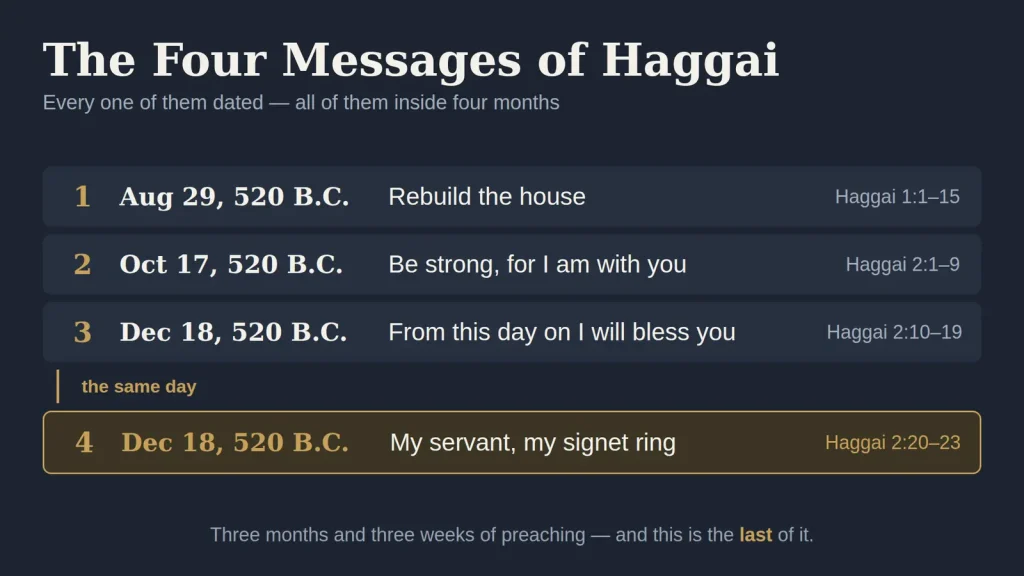
| Passage | Main emphasis |
|---|---|
| Haggai 1:1–15 | Examine your priorities and return to the work God has commanded. |
| Haggai 2:1–9 | Take courage because God is present and has promised greater glory. |
| Haggai 2:10–19 | Recognize your uncleanness and trust God’s promise of blessing. |
| Haggai 2:20–23 | Trust God’s sovereign purposes and His promise to Zerubbabel. |
Seven Lessons from the Book of Haggai
These lessons follow the book’s movement. Each begins with what God said to the returned exiles, then considers how we should respond today.
1. Stop Postponing Obedience (Haggai 1:1–8)
The people did not announce that the temple should never be rebuilt. They said the time had not yet come. Meanwhile, they found time to improve their own homes.
We should recognize that reasoning. We can postpone prayer until life settles down, postpone serving until our schedule opens up, or postpone a difficult conversation until it becomes easier. A delay can sound reasonable while allowing us to avoid something God has already made clear.
The problem was not that these people had houses. Providing for our families is a legitimate responsibility. The problem was that they consistently gave their own concerns attention while neglecting God’s command.
God gave them a concrete next step: gather the wood and build. Our response should become concrete too. If we know we should ask forgiveness, begin the conversation. If we have neglected Scripture, open our Bibles. Obedience must eventually move beyond our intentions.
Read the fuller study: Put God First: Stop Delaying Obedience.
2. Respond to God’s Correction with Repentance (Haggai 1:9–15)
The failed harvests and drought were not unexplained circumstances in this passage. God explicitly told the people that He was disciplining them for neglecting His house. They responded by fearing Him and obeying His Word.
We should not assume that every hardship in our lives is punishment for a particular sin. Haggai’s audience had a direct explanation from God. We often do not. Still, difficulty provides an appropriate occasion to examine ourselves and ask whether we are resisting something Scripture commands.
When the people responded, God assured them, “I am with you” (Haggai 1:13, ESV). He also stirred their spirits so that they returned to work. His gracious activity and their obedience went hand in hand.
Years of neglect did not make repentance pointless. That encourages anyone who wonders whether too much time has been wasted to begin obeying now.
Read the fuller study: What God Says When We Repent.
3. Keep Serving When the Work Seems Small (Haggai 2:1–5)
Some of the people remembered the former temple’s glory. What they saw before them seemed insignificant by comparison. They had resumed the work, but obedience had not removed their discouragement.
God called the leaders and the people to be strong and work. He grounded that command in His presence and the continuing presence of His Spirit among them. Their resources were limited, but God had not abandoned them.
Comparison can make faithful work feel worthless. A parent may compare the present with an easier season at home. A church member may compare a small ministry with one that receives far more attention. We can become so occupied with what the work lacks that we overlook the responsibility God has placed before us.
The encouragement is not that every small effort will become impressive. It is that God’s presence gives His people reason to keep going in the work He has called them to do.
Read the fuller study: God’s Answer to Discouragement.
4. Look Beyond Outward Splendor to Christ (Haggai 2:6–9)
God promised to shake the nations, fill His house with glory, and give peace. The people could see the limitations of their building, but they could not yet see the fullness of what God intended.
In my study of this passage, I explain the temple’s greater glory in relation to Jesus Christ. The Son of God would come to the temple. Its significance could not be measured simply by comparing its materials with Solomon’s building.
These verses raise interpretive questions, including the wording about the nations in verse 7. The ESV speaks of their treasures. My fuller study discusses the messianic reading behind the familiar expression “Desire of All Nations.” We should distinguish that interpretation from our translation’s wording.
Hebrews 12:26–28 explicitly takes up Haggai’s promise of shaking and directs believers to God’s unshakable kingdom. The passage should move us to examine what we are trusting and to worship God with gratitude and reverence.
Read the fuller study: Why the Second Temple’s Glory Was Greater Than Solomon’s.
5. Religious Activity Cannot Make You Holy (Haggai 2:10–14)
Haggai asked the priests questions about holiness and uncleanness under the law. Holy meat carried in a garment did not make other food holy when the garment touched it. Contact with an unclean person, however, did make the food unclean.
God applied the lesson to the people and their work. Their religious activity could not cancel their uncleanness. Working on a holy building did not automatically make the workers holy.
The application reaches into church life. Attending services, serving in ministry, giving, and owning a Bible are good things. But none can replace repentance and faith in Christ. We can be surrounded by Christian activity while refusing to bring our own sin into the light.
As I explain in the fuller study, Zechariah’s vision of Joshua’s filthy garments supplies a beautiful companion picture: God removes guilt and provides clean clothing. We need the cleansing and righteousness He provides, not confidence in our religious surroundings.
Read the fuller study: Why Religious Activity Cannot Make Us Holy.
6. Obey Before You Can See the Results (Haggai 2:15–19)
God told the people to look back at the scarcity they had experienced and to consider His promise of blessing. The temple was unfinished, and the crops He named had not yet produced their harvests. They had to trust His Word before the results were visible.
That pattern challenges the conditions we sometimes attach to obedience. We may be willing to speak gently if our spouse becomes easier to live with, serve if we can see immediate fruit, or make something right if we are assured of a favorable response.
Haggai does not give Christians a formula for becoming wealthy. The promise addressed these people in their particular covenant setting. Nor does obedience guarantee that a strained relationship, difficult ministry, or painful circumstance will quickly improve.
We obey because God is worthy of our trust. He may allow us to see encouraging results, but His faithfulness is not measured by whether events unfold on our timetable. The unfinished work and the waiting harvest remind us how much faithful living happens before we can see the outcome.
Read the fuller study: From This Day On I Will Bless You.
7. Trust the God Who Keeps His Promises (Haggai 2:20–23)
The final message addresses Zerubbabel. God declares His authority over earthly kingdoms and promises to make His chosen servant like a signet ring, an image of authority and recognition.
The promise is especially striking alongside Jeremiah’s judgment against Zerubbabel’s grandfather, Jehoiachin, whom God compared to a signet ring He would remove. Yet Zerubbabel was not crowned king. He remained a governor under Persian rule.
God had not forgotten His promise to David, and He had not treated His judgment lightly. Zerubbabel appears in the New Testament genealogies of Jesus, directing our attention beyond the governor’s lifetime to Christ’s coming.
We do not need to reconstruct every connection between those genealogies to see the larger encouragement: God preserved His purposes through judgment, exile, and circumstances that appeared to threaten them. The book ends by lifting our eyes from an unfinished building to the Lord who rules history.
Read the fuller study: Why God Called Zerubbabel His Signet Ring.
How Should Christians Apply Haggai Today?
We should begin by respecting the original setting. Haggai called the returned exiles to rebuild the temple in Jerusalem. We cannot simply treat every modern building project, ministry ambition, or personal goal as that same command.
But the book exposes familiar patterns: postponing obedience, making excuses for misplaced priorities, becoming discouraged by comparison, and trusting religious activity instead of coming honestly to God.
Choose one responsibility Scripture has already made clear. Identify the excuse you have attached to it. Then take one specific step of obedience while depending on the Lord. You may need to confess a sin, restore a neglected practice, ask someone’s forgiveness, or return to faithful service.
Let that response lead you to Christ. He is the Savior who cleanses sinners and fulfills God’s promises. Haggai’s call to work should never become an attempt to earn the acceptance that can only be received through Him.
Questions for Personal or Group Study
- Where have I been calling something “not the right time” when God’s command is already clear?
- How has comparison weakened my willingness to serve faithfully?
- Am I relying on Christian activity while avoiding repentance in a particular area?
- What step of obedience should I take even if the outcome remains uncertain?
Begin your own study: Read Haggai 1–2 in one sitting, then work through the seven linked passage studies above. Track what God commands, what He promises, and how His people respond.
Short Scripture quotations are from the English Standard Version (ESV).

